


Table of Contents
- Quick Comparison: Best Home Health Devices for Caregivers
- 1. Med-Pat CARE-4 Caregiver Pager System - Emergency Response and Alert
- 2. Best Blood Pressure Monitors for Seniors: Med-Pat BP-S and Daily Wellness Bundle
- 3. How to Use Pulse Oximeters for Home Care: Med-Pat PX-1
- 4. Emergency Communication Devices: TAFEA Auto Dialers and Amplified Phones
- 5. Med-Pat Total Health Bundle - Three Vital Signs in One Home Health Device Kit
- FSA Eligible Home Health Monitors: What Caregivers Need to Know
- Setup, Privacy, and Choosing the Right Devices for Non-Tech-Savvy Seniors
- Frequently Asked Questions
Last Updated: August 31, 2026
Caregiving at home demands tracking vital signs, managing medications, and responding to emergencies, often with limited tools. At Med-Pat Solutions, we provide reliable, FDA-cleared home health devices that work in real-world settings. The right devices give accurate readings, are simple enough for seniors to use independently, and require no subscriptions or smartphones.
Quick Comparison: Best Home Health Devices for Caregivers
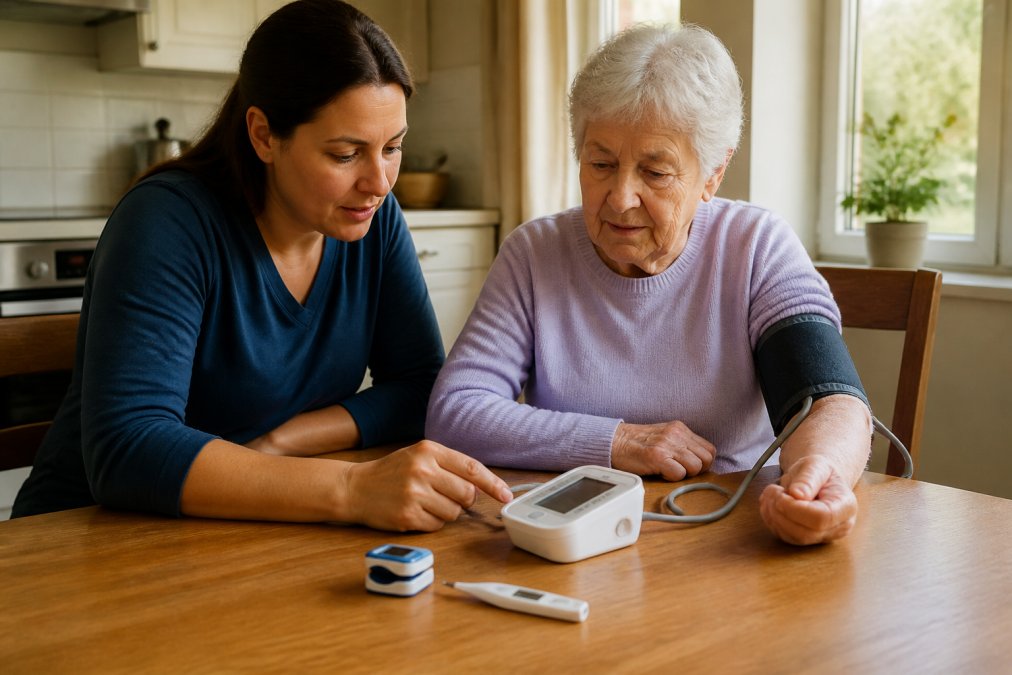
The best home health devices fall into three categories: vital sign monitors, emergency alert systems, and accessible communication tools. Each addresses a different layer of home safety and chronic condition management.
| Device | Price | Best For | No Subscription? | FSA/HSA Eligible? |
|---|---|---|---|---|
| Med-Pat CARE-4 Caregiver Pager | $34.99 | Emergency alerts, wandering prevention | Yes | No |
| Med-Pat BP-S Blood Pressure Monitor | $42.00 | Daily BP tracking, 3-user households | Yes | May apply |
| Med-Pat Daily Wellness Bundle | $47.99 | BP + oxygen monitoring combo | Yes | May apply |
| Med-Pat PX-1 Pulse Oximeter | $27.99 | SpO2 and pulse rate spot-checks | Yes | May apply |
| Med-Pat Total Health Bundle | $79.99 | Three vitals in one kit | Yes | May apply |
| FIRST by TAFEA Emergency Auto Dialer | $49.99 | Seniors living alone, simplest access | Yes | No |
| FIRST M by TAFEA Emergency Phone | $54.54 | Multi-contact emergency communication | Yes | No |
| Med-Pat XL88Q Large Button Phone | $34.99 | Hearing loss, bedside accessibility | Yes | No |
All Med-Pat monitoring devices are FDA-cleared for their intended use. None require monthly fees or internet connectivity.

1. Med-Pat CARE-4 Caregiver Pager System - Emergency Response and Alert
The CARE-4 solves the critical problem of receiving alerts while moving throughout the home. A wrist-worn touchscreen receiver delivers vibration, sound, and visual alerts whether you're in the kitchen or backyard. The 4-piece kit includes a waterproof IP65 emergency call button safe for shower use, where falls are most likely, and a door/window sensor that alerts you if a loved one with dementia opens an exterior door.
This system runs entirely on radio frequency, no Wi-Fi, no subscription, no app. The base station plugs into a wall outlet and supports 38 customizable ringtones at four volume levels. The wrist receiver charges via USB.
Best for: Caregivers who move around the home and need hands-free alerts. Ideal for dementia care with door monitoring.
Key specs:
- IP65 waterproof call button with lanyard
- Wrist-wearable touchscreen receiver with vibration and sound alerts
- Magnetic door/window contact sensor
- No Wi-Fi or monthly fees required
View the Med-Pat CARE-4 Caregiver Pager System
2. Best Blood Pressure Monitors for Seniors: Med-Pat BP-S and Daily Wellness Bundle
Hypertension management depends on consistent, accurate readings taken under the same conditions. The Med-Pat BP-S addresses usability directly with a 4.7-inch LCD display readable from a seated position, one-touch operation, and an adjustable cuff fitting arm circumferences from 8.66 to 16.53 inches. A WHO-style color indicator provides immediate visual reference without requiring users to interpret numbers.

Three-user memory is the standout feature for caregiving households, allowing separate reading histories without mixing data. For caregivers who also want oxygen saturation tracking, the Med-Pat Daily Wellness Bundle pairs the blood pressure monitor with the PX-1 Pulse Oximeter at $47.99. Both devices are standalone with no app, Bluetooth, or smartphone dependency.
According to American Heart Association guidance on home blood pressure monitoring, consistent home monitoring with a validated upper-arm device is recommended for adults managing hypertension, particularly when readings vary between clinic visits.
The BP-S uses intelligent inflation that adjusts pressure automatically, reducing discomfort during measurement. One-touch design accommodates users with limited hand dexterity.
3. How to Use Pulse Oximeters for Home Care: Med-Pat PX-1
A pulse oximeter measures blood oxygen saturation (SpO2) and pulse rate in seconds. For home care, it's most useful for people with chronic respiratory or heart conditions, or anyone recovering from illness where oxygen levels warrant monitoring.
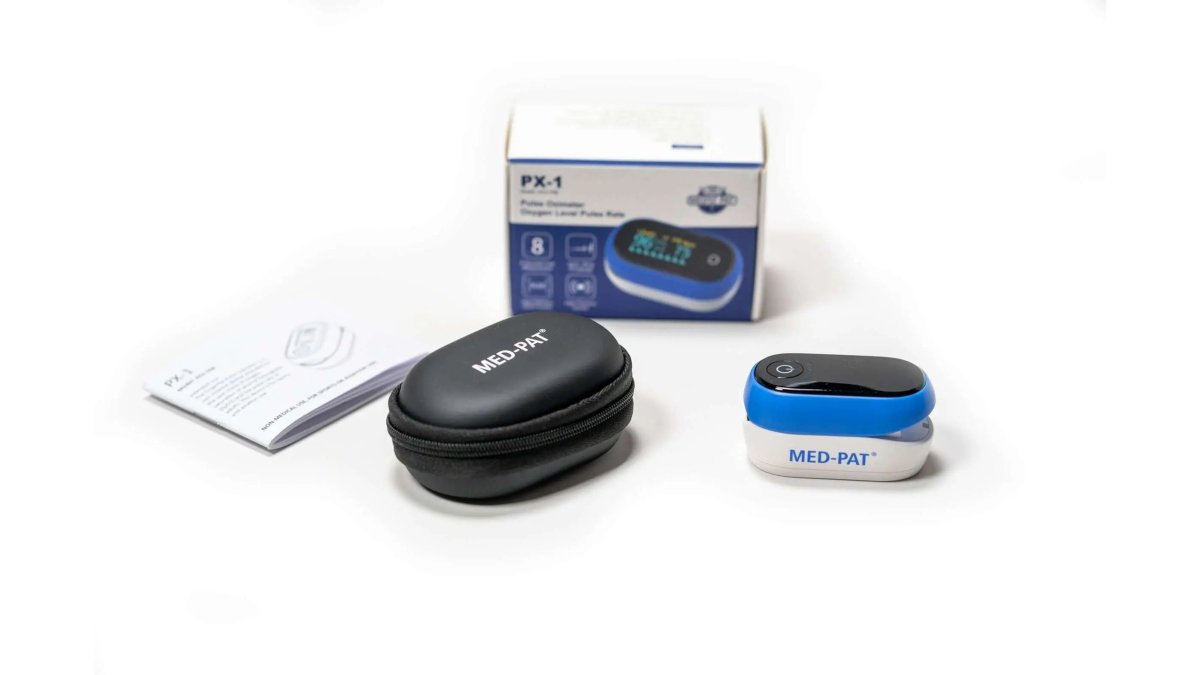
The Med-Pat PX-1 is FDA 510(k)-cleared for routine home spot-checks. Its OLED display shows SpO2, pulse rate, perfusion index (PI), and a plethysmograph waveform. A steady waveform confirms a strong signal and reliable reading, not a motion artifact.
How to use it correctly at home:
- Warm the hand first if cold; poor circulation reduces signal quality
- Clip to the index or middle finger, not the thumb
- Sit still and breathe normally for 30 seconds before reading
- Wait for the waveform to stabilize before recording SpO2
- Note the perfusion index; a very low PI can indicate poor circulation rather than true oxygen desaturation
Battery life is up to 30 hours on two AAA batteries, with 8-second auto-shutoff. The kit includes lanyard, protective case, and batteries.
As the FDA's guidance on pulse oximeter accuracy for home use notes, consumer pulse oximeters are intended for spot-check monitoring and should not be used as the sole basis for clinical decisions.
View the Med-Pat PX-1 Pulse Oximeter
4. Emergency Communication Devices: TAFEA Auto Dialers and Amplified Phones
Emergency communication is the safety layer most caregivers underestimate until needed. A senior who falls and can't reach a phone faces genuine danger. The right device prevents that gap.
FIRST by TAFEA Emergency Auto Dialer ($49.99): Lift the handset and the call is placed automatically to a pre-programmed number, no buttons, no dialing. The patented H.E.L.P. feature activates hands-free listening if the handset is dropped, increasing microphone sensitivity so responders can hear ambient sound even if the caller can't speak. The device is landline-powered, working during power outages as long as the phone line is active.
FIRST M by TAFEA Emergency Phone ($54.54): For settings needing multiple emergency contacts, the FIRST M offers four fully programmable memory buttons. M1 is pre-programmed to 911 by default but can be changed. The H.E.L.P. hands-free feature and recordable broadcast announcement are included.
For hearing-impaired seniors needing day-to-day phone accessibility, the Med-Pat XL88Q Large Button Phone ($34.99) pairs amplified audio with CLEARING AID circuitry, bright LED visual ring indicator, and high-contrast keys with Braille locator dot on the 5 key. It includes an adjustable bedrail holder, reducing fall risk from reaching across a bed.
The Med-Pat T-4 Trimline Telephone ($36.99) is the wall-mountable option with backlit keypad for low-light environments, CLEARING AID circuitry, and hearing aid compatibility. Both phones are line-powered with no batteries or charging needed.
5. Med-Pat Total Health Bundle - Three Vital Signs in One Home Health Device Kit
The Med-Pat Total Health Bundle ($79.99) includes three FDA-cleared devices: the TH-1 Infrared Thermometer, the BP-R Blood Pressure Monitor, and the PX-1 Pulse Oximeter. This is ideal for caregivers wanting a ready kit for routine checks, seasonal illness monitoring, or post-hospitalization recovery tracking. Each device operates standalone with no app, Bluetooth, or account creation.

What's in the bundle:
- TH-1 Infrared Thermometer: 4-in-1 design covering ear, forehead, object, and room temperature. Readings in approximately 1 second. Color-coded fever indicator (green/orange/red) for immediate interpretation. Silent mode for checking temperature without waking a sleeping person.
- BP-R Blood Pressure Monitor: FDA-cleared upper-arm monitor with 2.8-inch display, irregular heartbeat detection, and dual-user memory.
- PX-1 Pulse Oximeter: SpO2, pulse rate, perfusion index, and plethysmograph waveform on high-contrast OLED display.
The bundle costs less than purchasing each device separately.
View the Med-Pat Total Health Bundle
FSA Eligible Home Health Monitors: What Caregivers Need to Know
Med-Pat's monitoring devices may be eligible for FSA or HSA reimbursement. Eligibility is determined by your specific plan administrator, not the manufacturer. Blood pressure monitors are generally recognized as qualifying expenses under IRS Publication 502 on medical and dental expenses, but your plan's specific rules govern approval.
What caregivers should do before purchasing:
- Confirm with your FSA or HSA plan administrator that the specific device is covered
- Keep itemized receipts for reimbursement
- Check whether your plan requires a Letter of Medical Necessity
- Ask whether you can use your FSA debit card directly or must submit for reimbursement
Emergency alert systems and amplified phones are generally not FSA-eligible, as they are classified as communication or safety devices rather than medical monitoring equipment. There are no hidden subscription fees in any Med-Pat monitoring device. Data stays on the device itself with no cloud account, app, or ongoing cost.
Setup, Privacy, and Choosing the Right Devices for Non-Tech-Savvy Seniors
The biggest barrier to home health technology isn't cost, it's setup complexity. Devices requiring Bluetooth pairing, app downloads, or account creation will sit unused if the user isn't comfortable with smartphones.
Every Med-Pat device here functions without that. Power on, take a reading, read the display. The CARE-4 pager requires one-time component pairing via sync button. TAFEA emergency phones require programming a phone number into memory using simple keypad sequences.
Privacy and data security differ significantly for standalone devices versus connected platforms. Because Med-Pat's monitoring devices store data locally with no internet connectivity, there's no cloud server to breach, no account to hack, and no third-party data sharing. This contrasts with app-connected health trackers transmitting biometric data to external servers.
Choosing the right starting point:
| Situation | Recommended Device |
|---|---|
| Managing hypertension daily | Med-Pat BP-S or Daily Wellness Bundle |
| Respiratory condition monitoring | Med-Pat PX-1 or Total Health Bundle |
| Senior living alone, fall risk | CARE-4 Pager + FIRST Auto Dialer |
| Hearing loss, phone accessibility | XL88Q Large Button Phone or T-4 Trimline |
| New to home monitoring, want everything | Med-Pat Total Health Bundle |
| Budget-conscious, vitals only | Med-Pat PX-1 at $27.99 |
Setup typically takes under 10 minutes. The common mistake is skipping the cuff placement guide for blood pressure monitors; incorrect positioning produces consistently off readings. Sit with back supported, feet flat, arm at heart level, cuff on bare skin.
Caregiving is demanding enough without unreliable equipment. Med-Pat Solutions offers FDA-cleared home health devices including blood pressure monitors, pulse oximeters, thermometers, emergency pagers, and amplified communication tools, all designed for straightforward daily use with no subscriptions or app dependencies. Whether starting with a single pulse oximeter or equipping a full home monitoring setup, view the complete Med-Pat Solutions catalog and get the right tools in place before they're needed.
Frequently Asked Questions
Q: Are home health monitoring devices eligible for FSA/HSA funds?
A: Many FDA-cleared home health devices qualify as FSA/HSA eligible medical expenses, including blood pressure monitors and pulse oximeters. Med-Pat Solutions products are designed with FSA/HSA eligibility in mind, though final eligibility depends on your specific plan administrator. Always confirm with your plan before purchasing. Devices purchased for general wellness without a medical purpose may not qualify, so keeping documentation of a diagnosed condition can help when submitting a claim.
Q: What do caregivers need the most to monitor health at home?
A: The most practical starting point for home care monitoring is a blood pressure monitor, a pulse oximeter, and a thermometer. These three devices cover the vital signs most relevant to chronic condition management, including hypertension and respiratory health. An emergency alert or caregiver pager system adds another layer of safety for seniors aging in place. Choosing FDA-cleared devices with large displays and one-touch operation reduces daily friction for both caregivers and the people they support.
Q: What does FDA-cleared mean for a home health device?
A: FDA-cleared means the device has gone through the FDA's 510(k) review process and been determined to be substantially equivalent to a legally marketed device already on the market. It confirms the device is safe and effective for its intended use. For home health monitoring, FDA clearance is a meaningful quality signal. It does not mean the device is identical to clinical-grade equipment, but it does indicate the manufacturer met federal regulatory standards before selling it to consumers.
Q: How do wearable health devices assist family caregivers?
A: Wearable and wireless alert devices reduce caregiver anxiety by delivering real-time notifications when a loved one needs help. A wrist-worn caregiver pager, for example, lets a caregiver move freely around the house while still receiving instant alerts from an emergency button or door sensor. This supports aging in place by giving seniors independence while keeping caregivers informed. Devices that work without Wi-Fi or monthly subscriptions are especially practical for households where connectivity or tech comfort is limited.
Q: How do I choose a blood pressure monitor that gives accurate readings at home?
A: Choose an upper-arm monitor over a wrist model for daily home use, as upper-arm cuffs are generally more consistent for seniors. Look for FDA 510(k) clearance, a cuff that fits your arm circumference, and a large display for easy reading. Sit quietly for five minutes before measuring, keep your arm at heart level, and avoid talking during the reading. Taking measurements at the same time each day gives your care team the most useful data for chronic condition management.