


Table of Contents
- How We Selected the Best Blood Pressure Monitors for Seniors
- Quick Comparison: Top Blood Pressure Monitors at a Glance
-
The Top Blood Pressure Monitors for Seniors, Reviewed
- 1. Med-Pat Solutions Upper Arm Monitor: Best for Accessibility and Simplicity
- 2. Omron Platinum BP5465: Best for AFib Detection
- 3. Withings BPM Connect: Best for Automatic Data Synchronization
- 4. A&D Medical UA-767F: Best for Multi-User Households
- 5. Greater Goods Bluetooth Monitor: Best Budget-Friendly App-Connected Option
- 6. LifeSource UA-651: Best for No-Frills Simplicity
- 7. Omron Complete BP7900: Best for Combined BP and EKG Monitoring
- Blood Pressure Cuff Sizing for Seniors: Why It Matters More Than You Think
- How to Use a Blood Pressure Monitor at Home Correctly
- FSA HSA Eligible Blood Pressure Monitors: What You Need to Know
- Key Features Seniors Should Look for in a Blood Pressure Monitor
- Understanding Your Blood Pressure Readings and When to Call Your Doctor
- Frequently Asked Questions
Last Updated: August 31, 2026
Home monitoring is essential for managing hypertension and cardiovascular health in older adults. At Med-Pat Solutions, we've spent decades helping seniors find home health devices that work in daily life. Choosing the right blood pressure monitor matters: poor cuff fit, confusing displays, or unreliable accuracy mean missed readings or false reassurance. This guide ranks the best blood pressure monitors for seniors based on clinical validation, ease of use, accessibility, and real-world usability.
According to the American Heart Association's blood pressure monitoring guidance, consistent home monitoring is one of the most effective tools for managing hypertension, but only when the device is accurate and used correctly.
Quick Picks:
- Best for Accessibility: Med-Pat Solutions Upper Arm Monitor, designed for seniors with dexterity and vision challenges
- Best for AFib Detection: Omron Platinum BP5465, clinically validated with built-in atrial fibrillation screening
- Best for Auto Data Sync: Withings BPM Connect, Wi-Fi and Bluetooth sync with no manual logging
- Best Multi-User: A&D Medical UA-767F, stores readings for up to four users
- Best Budget App Option: Greater Goods Bluetooth Monitor, solid accuracy at lower price
- Best No-Frills: LifeSource UA-651, one button, done
- Best Combined BP + EKG: Omron Complete BP7900, for full cardiovascular monitoring
How We Selected the Best Blood Pressure Monitors for Seniors
Clinical validation is non-negotiable. Every monitor here has been validated using standardized protocols recognized by the Association for the Advancement of Medical Instrumentation.
We evaluated each monitor on criteria specific to older adults: cuff fit for typical senior arm sizes, large display legibility, one-button simplicity, arrhythmia detection, memory storage, connectivity options, FSA/HSA eligibility, and accessibility features for arthritis or low vision. We excluded wrist monitors, upper arm monitors are more accurate for older adults where reading precision is critical.
Quick Comparison: Top Blood Pressure Monitors at a Glance
| Monitor | Best For | AFib Detection | Bluetooth | Multi-User | FSA/HSA Eligible |
|---|---|---|---|---|---|
| Med-Pat Solutions Upper Arm | Accessibility and simplicity | Yes | Yes | Yes | Yes |
| Omron Platinum BP5465 | AFib detection | Yes | Yes | 2 users | Yes |
| Withings BPM Connect | Auto data sync | No | Yes + Wi-Fi | 8 users | Yes |
| A&D Medical UA-767F | Multi-user households | Yes (IHB) | No | 4 users | Yes |
| Greater Goods Bluetooth | Budget app-connected | Yes (IHB) | Yes | 2 users | Yes |
| LifeSource UA-651 | No-frills simplicity | Yes (IHB) | No | 1 user | Yes |
| Omron Complete BP7900 | Combined BP + EKG | Yes + EKG | Yes | 2 users | Yes |
The Top Blood Pressure Monitors for Seniors, Reviewed
1. Med-Pat Solutions Upper Arm Monitor: Best for Accessibility and Simplicity
Med-Pat Solutions built its upper arm monitor with caregivers and older adults at the center: gentle cuff inflation, large-print display readable without glasses, and controls that work with arthritic hands. The monitor is FDA-cleared, FSA/HSA eligible, and operates with one touch. No app is required, the device works independently, which matters for seniors living alone. For remote caregivers, the device also supports data sharing.
What works: Accessible design, FDA-cleared accuracy, no subscription fees, FSA/HSA eligible.
What to know: For seniors wanting automatic Wi-Fi syncing, the Withings BPM Connect (below) adds that capability.
2. Omron Platinum BP5465: Best for AFib Detection
Atrial fibrillation often goes undetected between doctor visits. The Omron Platinum BP5465 screens for arrhythmia with every measurement. The high-contrast dual backlit display shows current and previous readings side-by-side. TruRead Technology automatically takes three consecutive readings and averages them, reducing measurement variability. The D-ring cuff fits arm circumferences from 9" to 17", covering most adult arm sizes. Bluetooth connectivity syncs readings to the OMRON Connect app for unlimited tracking and provider sharing.
Pros: AFib detection, large backlit display, three-reading average, wide cuff range. Cons: Higher price ($174.95); app required for full data history.
3. Withings BPM Connect: Best for Automatic Data Synchronization
Most seniors who track blood pressure manually eventually stop. The Withings BPM Connect solves this at the hardware level. The device syncs automatically via Wi-Fi and Bluetooth to the Withings Health Mate app the moment a reading is taken, no button press, no pairing ritual, no manual entry. Instant color-coded feedback tells users whether readings fall within a healthy range. It supports up to eight user profiles and exports data directly to healthcare providers for telehealth appointments.
Pros: Automatic Wi-Fi sync, color-coded feedback, multi-user support, easy provider sharing. Cons: Requires a smartphone for full data access.
4. A&D Medical UA-767F: Best for Multi-User Households
The A&D Medical UA-767F stores 60 readings each for up to four users with time and date stamps. One-button operation keeps the learning curve flat. The AccuFit Plus Cuff fits arm circumferences from 8.6" to 16.5", and the large LCD screen is legible without magnification. Irregular heartbeat detection flags readings warranting physician follow-up. At $69.24, this offers strong value for households where multiple family members need monitoring.
Pros: Four-user memory, clinically validated, large display, one-button operation. Cons: No app connectivity; manual data sharing.
5. Greater Goods Bluetooth Monitor: Best Budget-Friendly App-Connected Option
The Greater Goods Bluetooth Smart Upper Arm Monitor measures systolic and diastolic pressure and pulse rate, syncs to the free Balance Health app, and stores 120 measurements for two users. The large backlit display and one-touch operation suit seniors frustrated by multi-step devices. An irregular heartbeat sensor and hypertension indicator bar provide visual alerts. The device includes both AAA batteries and an AC adapter, eliminating the "dead battery" problem.
Pros: Budget-friendly, free app, good accuracy, battery and AC power included. Cons: Cuff difficult to self-apply one-handed.
6. LifeSource UA-651: Best for No-Frills Simplicity
Some seniors want no app, no Bluetooth, just press one button, see a number, and know if it's in range. The LifeSource UA-651 delivers exactly that. One-button operation, irregular heartbeat detection, 60-reading memory, and clinically validated accuracy. The SlimFit cuff fits arm circumferences from 22 to 32 cm. At $49.99, it's the most affordable clinically validated option.
Pros: Extremely simple, affordable, clinically validated, irregular heartbeat detection. Cons: No app or connectivity, smaller cuff range, single-user memory.
7. Omron Complete BP7900: Best for Combined BP and EKG Monitoring
For seniors managing atrial fibrillation or other arrhythmias, the Omron Complete BP7900 measures blood pressure and records a medical-grade EKG simultaneously, detecting AFib, tachycardia, bradycardia, and normal sinus rhythm in one session. Developed with AliveCor, it's FDA-cleared and connects to the OMRON Connect app via Bluetooth for unlimited data storage and provider sharing. The D-ring cuff fits arms 9" to 17". At $199.99, this replaces two devices for seniors whose cardiologist requests home monitoring of both blood pressure and heart rhythm.
Pros: Combined BP and EKG, FDA-cleared, AFib/tachycardia/bradycardia detection. Cons: Highest price; unnecessary for seniors needing only standard BP monitoring.
Blood Pressure Cuff Sizing for Seniors: Why It Matters More Than You Think
The wrong cuff size is the single most common cause of inaccurate home blood pressure readings. A cuff too small produces artificially high readings; too large produces artificially low readings.

Wrap a soft tape measure around the upper arm at the midpoint between shoulder and elbow. According to National Institutes of Health guidance on blood pressure measurement, using the correct cuff size is essential for consistency and clinical validity.
| Arm Circumference | Cuff Size Needed |
|---|---|
| Under 22 cm | Small / pediatric cuff |
| 22-32 cm | Standard adult cuff |
| 33-42 cm | Large adult cuff |
| Over 42 cm | Extra-large / thigh cuff |
Many seniors have larger arm circumferences than expected. When in doubt, measure.
How to Use a Blood Pressure Monitor at Home Correctly
Correct technique produces consistent readings. Inconsistent technique produces alarming variability.
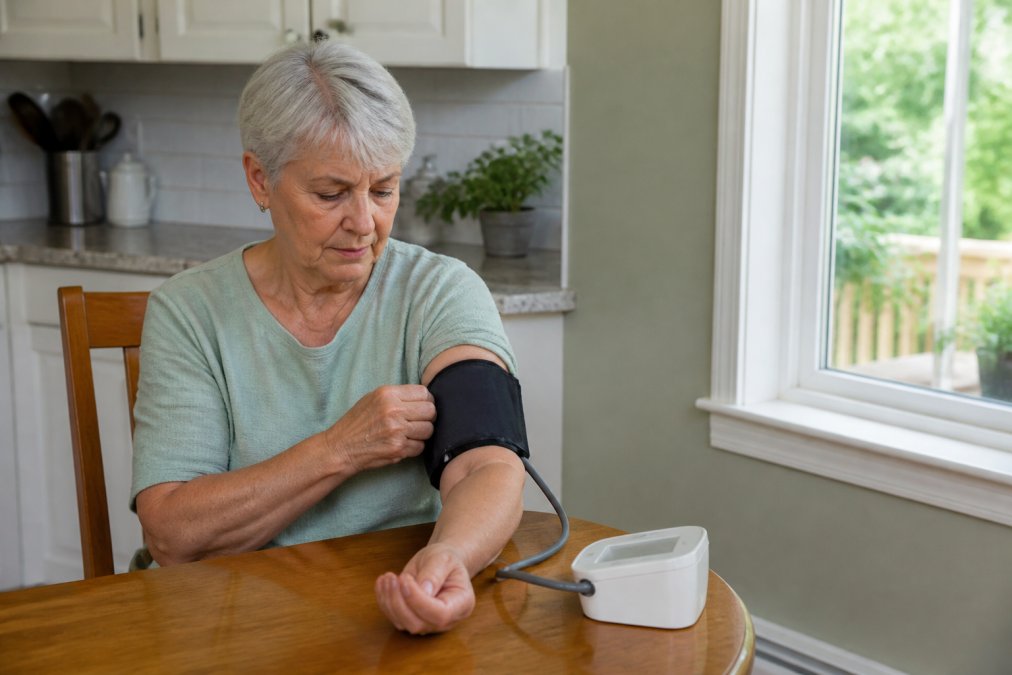
Follow these steps every time:
- Rest for five minutes before measuring. Sit quietly with feet flat and back supported.
- Avoid caffeine, exercise, and smoking for at least 30 minutes before measuring.
- Position your arm correctly. Rest your left arm on a flat surface with palm facing up. The cuff should sit approximately one inch above the elbow bend.
- Apply the cuff snugly, two fingers should fit under it, but it shouldn't be loose enough to shift.
- Sit still and don't talk during measurement. Movement and speech affect readings.
- Take two readings two to three minutes apart and record both.
- Measure at the same time each day, typically morning and evening, for useful longitudinal data.
White coat hypertension, elevated readings caused by medical anxiety, is common. Consistent home readings in a calm environment give a more accurate picture of true baseline blood pressure than occasional clinic measurements.
Troubleshooting Common Error Codes and Inaccurate Readings
Most digital monitors display error codes when a reading cannot be completed:
- Movement error (Err or E1): The arm moved during measurement. Sit still and retake.
- Cuff pressure error (E2): The cuff inflated unusually high, often because it's too loose. Reapply snugly and retry.
- Irregular pulse detected: The device flagged an irregular heartbeat. Retake the reading. If it appears consistently, note it for your doctor.
- Widely varying readings: Check cuff positioning, arm placement, and time of day. Readings after activity, stress, or large meals will be higher.
- Device reads significantly different from clinic: A 5-10 mmHg difference is common. A consistently larger discrepancy warrants a calibration check, bring the device to your next appointment for comparison.
FSA HSA Eligible Blood Pressure Monitors: What You Need to Know
FSA/HSA eligible blood pressure monitors qualify for purchase using pre-tax funds from a Flexible Spending Account or Health Savings Account. This applies to most clinically validated upper arm monitors, including all seven devices reviewed here. Using FSA or HSA funds reduces out-of-pocket cost by your marginal tax rate. There are no hidden subscription fees to access your own readings on any device listed here; companion apps are free.
To confirm eligibility, check the IRS's published list of qualified medical expenses or verify with your FSA/HSA plan administrator. The IRS Publication 502 on medical and dental expenses outlines eligible expense categories. Med-Pat Solutions products are FSA/HSA eligible. FSA funds typically expire at year-end, making a blood pressure monitor a straightforward eligible purchase providing lasting value.
Key Features Seniors Should Look for in a Blood Pressure Monitor
A blood pressure monitor for a 70-year-old managing hypertension has different requirements than one for a 40-year-old tracking wellness.
Accessibility Features for Seniors with Dexterity or Vision Challenges
Arthritis affects a significant portion of adults over 65, making small buttons, tight clasps, and fiddly cuff mechanisms genuinely difficult. Vision changes make small displays frustrating or unreadable.
Features to prioritize: large-print displays over 3 cm digit height with backlighting, one-button operation, D-ring cuff design for one-handed application, audible readouts for seniors with low vision, and light cuff inflation pressure to reduce discomfort.
Connectivity, Telehealth Integration, and Long-Term Accuracy
Telehealth appointments are now standard for cardiovascular care. A monitor that automatically logs readings to a shareable digital record removes friction. Bluetooth alone requires opening an app and syncing. Wi-Fi-enabled devices like the Withings BPM Connect sync automatically, producing more complete data. Check whether the app integrates with Apple Health, Google Fit, or your healthcare provider's patient portal.
Most home blood pressure monitors maintain calibration for two to three years under normal use. If a device has been used for several years or dropped, a calibration check is worthwhile. Bring it to a pharmacy or clinic with a validated reference device. If readings consistently fall outside acceptable margins, replacement is typically the practical solution.
Understanding Your Blood Pressure Readings and When to Call Your Doctor
Blood pressure is expressed as systolic over diastolic pressure. Systolic is the force when your heart beats; diastolic is the pressure between beats. A reading of 120/80 mmHg is generally considered the upper boundary of normal.
According to the Centers for Disease Control and Prevention's blood pressure categories, readings consistently above 130/80 mmHg meet the clinical threshold for hypertension. Stage 2 hypertension, readings at or above 140/90 mmHg, typically warrants medication management alongside lifestyle changes.
Call your doctor or seek urgent care if:
- A single reading is at or above 180/120 mmHg (hypertensive crisis)
- You experience chest pain, shortness of breath, or sudden severe headache with a high reading
- Readings have been consistently elevated for several days despite medication
- Your monitor repeatedly flags irregular heartbeat or arrhythmia
Track, don't panic. A single high reading after a stressful morning or coffee doesn't mean hypertension is out of control. Home monitoring's value is the pattern over time, which is why consistent technique, proper cuff sizing, and reliable logging matter. Sharing a complete digital log with your physician is far more useful than reporting a single number from memory.
Frequently Asked Questions
What is the easiest blood pressure monitor for seniors to use?
Upper arm monitors with one-button operation, large-print displays, and automatic inflation are generally the easiest for seniors. Features like a backlit screen, clear digit size, and a pre-formed cuff that guides correct placement reduce the chance of user error. FDA-cleared monitors that have been clinically validated for accuracy give added confidence. Seniors with arthritis or limited hand strength should prioritize monitors with wide, easy-wrap cuffs rather than wrist-style devices, which require precise positioning to deliver accurate readings.
Are home blood pressure monitors FSA or HSA eligible?
Yes. The IRS classifies blood pressure monitors as qualified medical expenses, making them eligible for purchase with FSA (Flexible Spending Account) or HSA (Health Savings Account) funds. This applies to upper arm and wrist cuff-style monitors used for home health management. You do not need a prescription. Always confirm eligibility with your plan administrator before purchasing, as plan rules can vary. Med-Pat Solutions products are FSA/HSA eligible, which can meaningfully reduce your out-of-pocket cost.
How often should seniors check their blood pressure at home?
Most clinical guidelines suggest measuring blood pressure twice in the morning before taking medications and twice in the evening, then averaging the results. Doing this for seven consecutive days before a medical appointment gives your doctor the most useful data. Daily cardiovascular monitoring helps identify patterns like white coat hypertension, where readings spike in a clinical setting but stay normal at home. Always follow your healthcare provider's specific recommendations, as frequency may vary based on your diagnosis and treatment plan.
What blood pressure cuff size do seniors need?
Cuff size is determined by arm circumference, not height or weight. Measure around the midpoint of your upper arm. Most standard adult cuffs fit circumferences between 22 and 42 centimeters (roughly 9 to 17 inches). A cuff that is too small produces falsely high systolic and diastolic readings, while one that is too large reads falsely low. Many monitors marketed for seniors include wide-range cuffs that accommodate most arm sizes. If you are unsure, measure your arm before purchasing and check the product's listed cuff circumference range.
Can I share my home blood pressure readings with my doctor through an app?
Yes, many modern upper arm monitors with Bluetooth connectivity or Wi-Fi sync readings automatically to a companion mobile application. From there, readings can be exported as a PDF or shared directly with a telehealth provider or physician's patient portal. This data synchronization removes the need for manual logging and gives clinicians a longer-term picture of your vascular health. If tech setup feels daunting, models without app connectivity still store 60 to 120 readings in onboard memory, which a doctor can review at your next visit.
Med-Pat Solutions has supported families and seniors in managing their health at home since 1986. If you're ready to find a blood pressure monitor that fits your daily routine, your arm size, and your comfort level with technology, browse the Med-Pat Solutions FDA-cleared home monitoring devices, all FSA/HSA eligible, with accessible designs built for real people. View cart and start monitoring with confidence.
This article was written using GrandRanker